

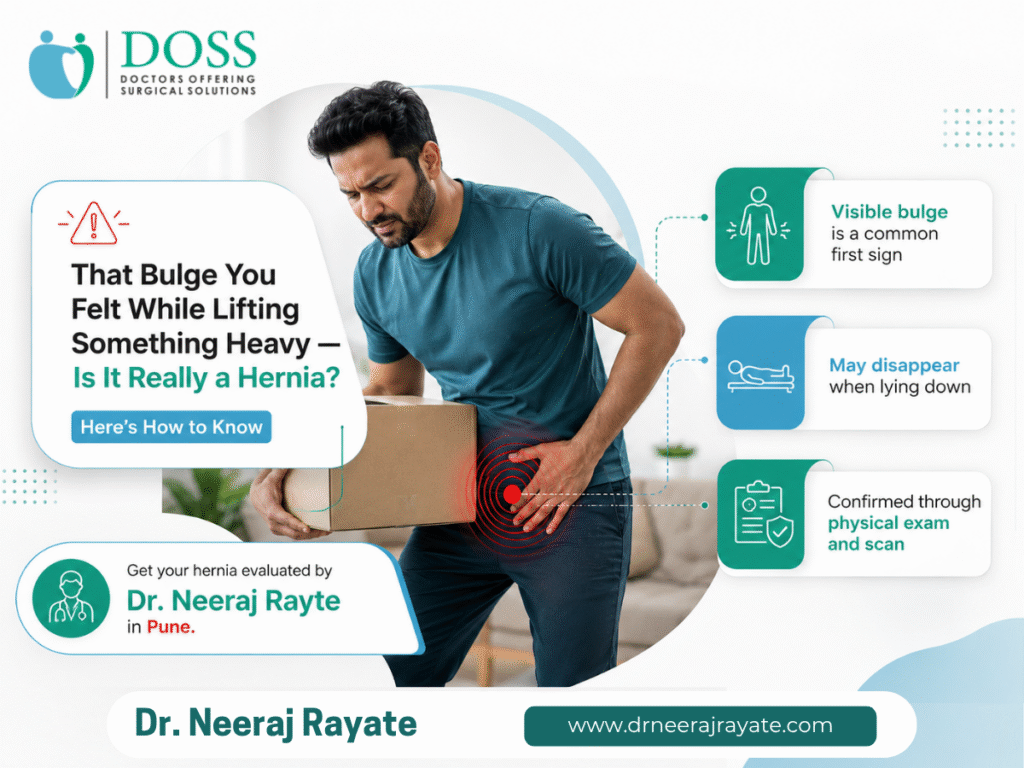
You bend down to lift a suitcase, a grocery bag, or a gym weight, and something feels off. A small lump appears near your groin or belly button, maybe with a pulling sensation, and then it’s gone once you stand up straight or lie down. It’s easy to shrug this off as a strained muscle. Sometimes that’s exactly what it is. But sometimes it’s the first visible sign of a hernia, and knowing the difference matters more than most people realize.
What Actually Happens When a Hernia Forms
A hernia occurs when an internal organ or tissue, often part of the intestine, pushes through a weak spot in the surrounding muscle wall, usually in the abdomen or groin. According to the Mayo Clinic, this creates a bulge that can be painful, especially when coughing, bending over, or lifting a heavy object, although many hernias cause little to no pain at all.
The weak spot itself isn’t usually caused by a single lifting session. As InformedHealth, a resource published by Germany’s Institute for Quality and Efficiency in Health Care, explains, activities like heavy lifting, coughing, and straining tend to make an existing weakness worse rather than create it from nothing, though the exact mechanism can vary depending on the type of hernia. In simple terms, the weak spot is often already there. Heavy lifting is frequently the moment it becomes noticeable, not necessarily the root cause.
Is It a Hernia or Just a Strained Muscle?
This is the question most people actually want answered, and there are a few practical ways to tell the two apart.
- Location and shape of the bulge. A hernia typically appears as a distinct, localized lump, most often in the groin, near the belly button, or along a previous surgical scar. A muscle strain usually causes generalized soreness without a visible or palpable lump.
- Behavior when you change position. A hallmark sign of a hernia is that the bulge becomes more noticeable when you stand, cough, or strain, and may reduce or disappear when you lie down and relax. Muscle strain pain doesn’t shift this way based on position.
- Persistence over time. Muscle strains generally improve within a few days to two weeks with rest. A hernia bulge does not go away on its own and often becomes more noticeable over weeks or months, even if the discomfort comes and goes.
- Associated sensations. A burning, aching, or heavy dragging feeling around the bulge is commonly reported with hernias, according to Mayo Clinic, whereas a strain tends to feel more like general muscular tightness or soreness across a wider area.
If a lump appears and doesn’t fully resolve within a week or two, or reappears every time you strain or lift, it’s reasonable to treat it as a possible hernia until a doctor confirms otherwise.
Why Heavy Lifting Is Such a Common Trigger
Hernias are more common than many people assume. Research summarized by InformedHealth notes that about 25 out of 100 men and 2 out of 100 women will experience an inguinal hernia, the most common type, at some point in their lives, making it one of the most frequent reasons for elective surgery worldwide.
Heavy lifting plays a well-documented role in triggering symptoms because it sharply raises intra-abdominal pressure. When that pressure is applied against a muscle wall that already has a weak point, whether from age, prior surgery, genetics, or chronic strain, tissue can push through and become visible as a bulge. This is why hernias are frequently reported by people in physically demanding jobs such as construction, warehousing, and manufacturing, as well as by regular gym-goers who lift without proper form or breathing technique.
It’s worth noting that lifting alone rarely causes a hernia in an otherwise structurally sound abdominal wall. It’s usually the combination of an existing weakness and a sudden spike in pressure that brings symptoms to the surface.
Why You Shouldn’t Ignore It
A hernia will not heal or close up on its own. Left unaddressed, it can gradually increase in size and, in some cases, lead to a serious complication called strangulation, where the trapped tissue loses its blood supply. This is considered a medical emergency and typically requires immediate surgery.
That’s why timely hernia treatment matters, even if the bulge isn’t currently painful. Watching a hernia “for now” is sometimes appropriate under medical supervision, but self-diagnosing and ignoring it entirely is where real risk creeps in.
Signs that warrant prompt medical attention include:
- A bulge that suddenly becomes firm, discolored, or increasingly painful
- Nausea, vomiting, or fever alongside the bulge
- Inability to push the bulge back in when lying down, when it previously could be
- Rapidly worsening pain in the area of the lump
Any of these can indicate the hernia has become incarcerated or strangulated, and it should be treated as urgent.
Getting the Right Hernia Treatment
The only definitive way to confirm a hernia is a physical examination by a doctor, sometimes supported by an ultrasound or CT scan if the diagnosis isn’t clear on exam alone. Once confirmed, treatment usually depends on the hernia’s size, location, and how much it’s affecting daily life.
Modern hernia treatment ranges from watchful waiting for small, symptom-free hernias to surgical repair, which remains the only way to permanently close the weak spot. Advances in laparoscopic and minimally invasive techniques have made recovery considerably faster and less disruptive than older open-surgery approaches, with many patients returning to normal activity within a couple of weeks.
Dr. Neeraj Rayte often reminds patients that the goal of an early evaluation isn’t to alarm them, but to catch a hernia while it’s still small and straightforward to treat, rather than waiting until it grows or becomes an emergency.
How We Can Help
If you’ve noticed a bulge while lifting something heavy and you’re not sure whether it’s a strain or something more, it’s worth getting it looked at rather than waiting to see if it goes away. Dr. Neeraj Rayte specializes in diagnosing and managing hernias of all types, from inguinal to umbilical and incisional, and offers modern, minimally invasive hernia treatment in Pune tailored to each patient’s condition and lifestyle. Whether you need a straightforward evaluation or a full surgical plan, getting an accurate diagnosis early is the best way to avoid complications down the line. If that bulge hasn’t gone away, it’s time to get it checked.
Frequently Asked Questions
- How do I know if a bulge from lifting is a hernia and not just a muscle strain? A hernia usually appears as a distinct, localized lump that becomes more visible when standing, coughing, or straining, and may shrink when you lie down. It also doesn’t resolve within a week or two the way a simple muscle strain typically does. If the lump persists or keeps reappearing, it’s best to have it examined by a doctor.
- Can heavy lifting alone cause a hernia? Lifting alone rarely causes a hernia in an abdominal wall that has no existing weakness. Most hernias develop when heavy lifting or straining puts sudden pressure on a spot that was already structurally weak, whether from genetics, age, prior surgery, or chronic strain. Lifting is more often the trigger that makes an existing hernia noticeable.
- Is surgery always necessary for hernia treatment? Not always. Small, symptom-free hernias may be monitored under medical supervision for a period of time. However, hernias don’t heal on their own, and surgery remains the only way to permanently repair the weak spot. A doctor can advise whether watchful waiting or surgical hernia treatment is the right approach for your specific case.
#HerniaTreatment #HerniaTreatmentInPune #HerniaAwareness #AbdominalHealth #MinimallyInvasiveSurgery #GutHealth #HealthyLifting #SurgicalCare #WellnessJourney #FitnessSafety