

Setting Honest Expectations Before Weight Loss Surgery
Loose skin after substantial weight loss can feel confusing. A person may be healthier, lighter and more active, yet still feel uncomfortable because skin folds remain around the abdomen, arms, thighs, chest or neck. This does not mean that weight loss surgery failed. It reflects the difference between losing fat and the skin’s ability to contract around a smaller body.
The amount of loose skin varies widely. Some people develop only mild laxity, while others experience folds that affect clothing, hygiene, movement and body confidence. A responsible discussion before weight loss surgery in Pune should include this possibility without allowing it to overshadow the health benefits of treating severe obesity.
Why Does the Skin Not Always Shrink Back?
Skin contains collagen and elastin fibres that provide strength and recoil. When the body remains at a higher weight for years, the skin and supporting tissues stretch to accommodate the larger volume. After rapid or major fat loss, that volume decreases faster than overstretched tissue can remodel.
A 2024 histological study indexed by the National Library of Medicine describes changes in collagen and elastin after massive weight loss. These structural changes help explain why significant excess skin usually cannot be completely reversed with creams or exercise.
What Determines How Much Loose Skin Develops?
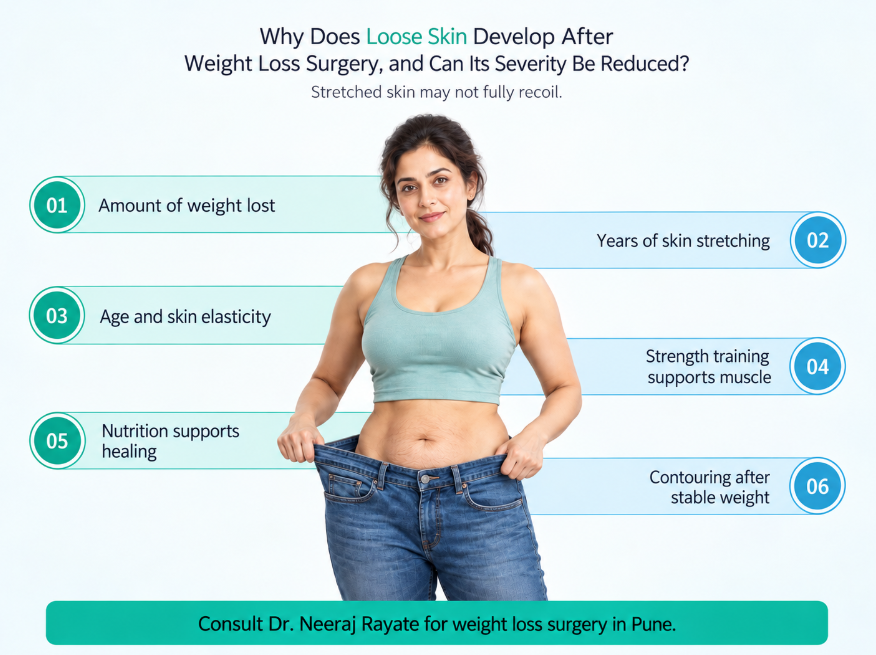
Important influences include:
- Total amount of weight lost and how widely fat was distributed
- How long the skin remained stretched before surgery
- Age and inherited skin elasticity
- Smoking and long-term sun exposure, which can damage collagen
- Pregnancy history and previous weight cycling
- Muscle mass and nutritional health
- The body areas from which fat is lost
Rapid loss is often blamed, but slowing medically effective weight loss purely to prevent loose skin is not proven to eliminate the problem. The total change in body volume and baseline tissue quality are major factors.
Can Exercise Prevent Loose Skin?
Exercise cannot remove extra skin, but resistance training can build or preserve muscle beneath it. This may improve shape, strength and function. It can also help maintain weight loss and make daily activity easier.
The result should be described honestly. Muscle cannot fill all the space left by a large loss of fat, and aggressive bodybuilding is not an appropriate substitute for reconstructive treatment when folds are severe.
Patients should begin exercise according to their bariatric team’s recovery plan. Protein intake, hydration and gradual progression are especially important during rapid weight loss.
Do Protein, Water or Creams Tighten the Skin?
Adequate protein, fluids, vitamins and minerals support healing, hair, muscle and overall skin health. They are essential after weight loss surgery in Pune, particularly because reduced food intake and altered absorption can cause deficiencies.
However, no food, collagen supplement, oil or cream has been proven to remove a substantial apron of excess skin. Moisturisers may improve dryness and comfort. Sun protection and avoiding tobacco help protect remaining collagen, but they cannot undo years of stretching.
Patients should be cautious about products promising to “melt” or permanently tighten large folds without surgery. Non-surgical energy devices may offer modest improvement for mild laxity, but results are not equivalent to removing significant excess tissue.
Practical Ways to Reduce Discomfort
While the body is stabilising, several steps may improve day-to-day comfort:
- Keep folds clean and dry, particularly after exercise.
- Use breathable clothing and well-fitted supportive garments.
- Seek treatment for recurrent rashes, fungal infections or skin breakdown.
- Continue prescribed supplements and attend nutritional blood tests.
- Build strength progressively under suitable guidance.
- Document persistent medical problems if reconstructive assessment may be needed.
Compression clothing can improve comfort and appearance under clothes, but it does not permanently tighten skin.
When Is Body-Contouring Surgery Considered?
Body-contouring surgery removes excess skin and reshapes underlying tissue. Procedures may include abdominoplasty or panniculectomy, arm lift, thigh lift, breast reshaping and lower-body lift.
The American Society of Plastic Surgeons explains that body contouring after major weight loss can remove excess skin and improve the tone of underlying tissue. It is a separate operation from bariatric surgery and should be planned with a qualified plastic surgeon.
Candidates are usually asked to reach a stable weight, stop smoking and correct nutritional problems before surgery. Operating while weight is still changing can affect healing and the durability of the result. Multiple areas may need staged procedures rather than one very long operation.
Does Everyone Need Skin-Removal Surgery?
No. Some people are comfortable with mild loose skin and do not want another procedure. Others experience repeated rashes, difficulty exercising, hygiene problems or substantial distress and wish to explore body contouring.
The decision is personal. It should consider health, nutritional status, scar expectations, recovery time, cost and the risks of wound complications. Body contouring improves shape but does not create perfectly tight skin or eliminate every fold.
Keep the Main Health Goal in Perspective
Fear of loose skin should not be the only factor in deciding whether to treat severe obesity. Bariatric surgery can support meaningful weight loss and improvement in obesity-related disease. ASMBS patient information notes that the greatest weight loss often occurs within the first one to two years.
A clear preoperative conversation allows patients to prepare emotionally and practically. The goal is not to promise that loose skin can be prevented, but to explain what may help, what cannot be controlled and what later options exist.
Frequently Asked Questions
- Will everyone have loose skin after bariatric surgery?
No. The amount varies with weight lost, age, genetics, skin quality and how long the tissue was stretched. Mild laxity is common, but severe folds do not occur to the same degree in everyone.
- Can exercise completely tighten loose skin?
Exercise can improve muscle tone, strength and body shape, but it cannot remove significant excess skin. Surgical body contouring is the most predictable option when large folds remain.
- When can skin-removal surgery be considered?
It is generally considered after weight has stabilised and nutritional health is adequate. Timing must be determined by the bariatric and plastic-surgery teams rather than a fixed date alone.
Consult Dr. Neeraj Rayate for Weight Loss Surgery in Pune
Patients deserve realistic preparation before treatment and structured support afterward. Those considering weight loss surgery in Pune can consult Dr. Neeraj Rayate to discuss expected weight change, nutrition, exercise and long-term follow-up. If excess skin later causes functional problems, referral for an appropriate plastic-surgery assessment may be discussed.
This article provides general information and does not replace individual surgical or nutritional advice.
#weightlosssurgery #looseskin #bariatricjourney #bodycontouring #obesitycare #punehealthcare