

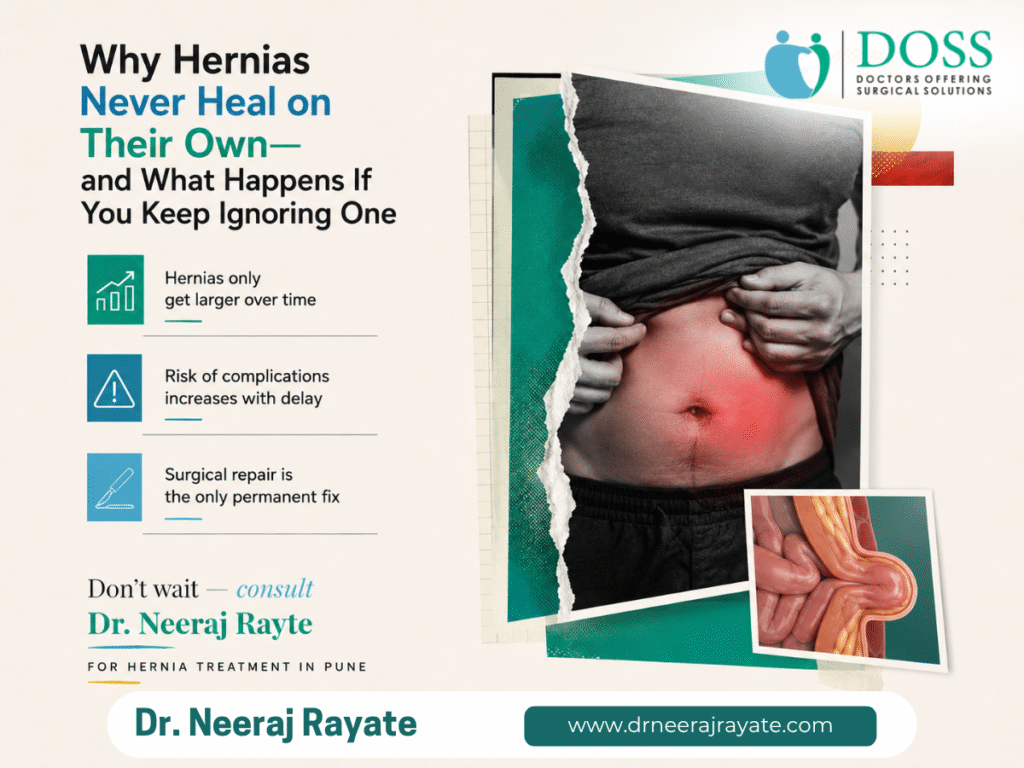
When should you consider hernia treatment in Pune?
Written for: Dr. Neeraj Rayate
Prepared for medical review by: Dr. Neeraj Rayate, Laparoscopic and Bariatric Surgeon
Last updated: 31 July 2026
A hernia may begin as a small, painless bulge that appears only while coughing, lifting or standing. Because it may disappear when you lie down, it is easy to assume that the problem has resolved. Unfortunately, an adult hernia does not repair itself simply because the swelling temporarily goes back inside.
A hernia develops when fat, intestine or another tissue pushes through a weak area or opening in the abdominal wall. The bulge may move in and out, but the underlying defect remains.
If you are considering hernia treatment in Pune, understanding what happens inside the abdominal wall can help you decide when monitoring is reasonable and when delaying treatment may become risky.
Why an Adult Hernia Cannot Heal Naturally
Muscle strains and minor injuries may heal because the damaged tissues can reconnect. A hernia is different. It involves a structural opening or weak area in the muscle and connective tissue.
Once abdominal tissue begins pushing through that opening, the body cannot usually close the defect by itself. The pressure created by coughing, constipation, weight gain, heavy straining or everyday movement may continue to push tissue through the weak area.
The National Institute of Diabetes and Digestive and Kidney Diseases describes an inguinal hernia as abdominal contents bulging through a weak area in the lower abdominal wall. It estimates that approximately 27 percent of men and 3 percent of women develop an inguinal hernia during their lifetime.
Small umbilical hernias in young children are an important exception because some can close naturally as the abdominal wall develops. This article focuses on adult inguinal, umbilical, incisional and other abdominal wall hernias, which generally do not close without surgical repair.
Why the Bulge Sometimes Disappears
A reducible hernia may become smaller or move back into the abdomen when you lie down or apply gentle pressure. This can create a false sense that the hernia has healed.
Reduction only means the tissue has temporarily moved back through the opening. The opening itself is still present. When pressure inside the abdomen increases again, the bulge may return.
A hernia belt or supportive garment may temporarily reduce discomfort in selected patients, but it does not repair the abdominal wall defect. Exercises, massage and home remedies cannot close the opening either.
What Can Happen When a Hernia Is Ignored?
Some hernias remain relatively stable for a period, while others gradually become larger or more uncomfortable. Possible changes include:
- Increasing size: Repeated pressure may stretch the weak area and allow more tissue to pass through it.
- Pain or heaviness: A painless bulge may begin causing pulling, burning or aching during walking, coughing or lifting.
- Reduced daily activity: People may avoid exercise, travel or work because they are worried about discomfort or the bulge becoming larger.
- Incarceration: The hernia contents may become trapped and no longer move back into the abdomen.
- Strangulation: Blood flow to the trapped tissue may be cut off, potentially damaging the intestine and creating a surgical emergency.
According to the NIDDK, a strangulated inguinal hernia can cause intestinal obstruction and tissue death when part of the intestine becomes trapped and loses its blood supply.
However, complications are not inevitable, and the risk is different for every hernia. The type, size, location, symptoms and patient’s overall health all influence the treatment decision.
Does Every Hernia Need Immediate Surgery?
Not necessarily. Watchful waiting may be appropriate for selected adults when the hernia is small, easily reducible and causes little or no discomfort.
International HerniaSurge guidelines support watchful waiting as an option for some men with asymptomatic or minimally symptomatic inguinal hernias because the short term risk of an emergency is relatively low.
Watchful waiting does not mean ignoring the hernia. It involves a proper diagnosis, understanding warning signs and attending follow up appointments. Surgery may be recommended if the hernia grows, becomes painful, affects daily activity or becomes difficult to reduce.
The American College of Surgeons states that very small, reducible and painless adult umbilical hernias may sometimes be observed. It reports a 4 percent risk of strangulation within five years when an umbilical hernia is not repaired. This percentage applies to the type of hernia discussed in its patient guidance and should not be treated as a universal risk for every hernia.
Why Planned Surgery May Be Safer Than Emergency Surgery
Elective hernia repair is scheduled after assessing the patient’s health, medicines, hernia type and suitable surgical approach. This allows time to manage factors such as smoking, diabetes, excess weight or other conditions that may affect recovery.
Emergency surgery is different. If intestine becomes trapped or strangulated, the surgeon may need to operate urgently. Damaged intestine may occasionally need to be removed, making treatment more complex.
The goal of planned repair is not simply to remove the visible bulge. The surgeon returns the protruding tissue to its proper position and closes or reinforces the abdominal wall defect. Depending on the hernia, repair may be performed through open, laparoscopic or robotic surgery, with sutures or mesh selected according to clinical requirements.
When Should You Seek Urgent Medical Care?
Seek immediate medical attention if you notice:
- Sudden or rapidly worsening pain around the hernia
- A bulge that becomes hard, tender or cannot be pushed back
- Red, purple or dark skin over the swelling
- Abdominal bloating with nausea or vomiting
- Fever
- Inability to pass stool or gas
These symptoms may indicate incarceration, bowel obstruction or strangulation. Trying to force a painful or trapped hernia back inside can be unsafe and should be avoided.
How a Surgeon Decides the Right Treatment
A personalised assessment generally considers:
- Hernia type and location: Inguinal, femoral, umbilical and incisional hernias do not carry identical risks.
- Size and reducibility: The surgeon checks whether the bulge moves back inside and whether the opening is increasing.
- Pain and activity limitations: Symptoms during work, exercise, coughing or routine movement can affect the treatment decision.
- Medical history: Age, weight, previous surgery, diabetes, smoking and heart or lung conditions may influence planning.
- Suitable repair technique: Open, laparoscopic or robotic repair may be considered according to the hernia and the patient’s clinical needs.
Imaging such as ultrasound or CT scanning is not required for every obvious hernia, but it may be advised when the examination is unclear or complications are suspected.

Expert Perspective from Dr. Neeraj Rayate
The size of a hernia alone does not determine whether treatment is urgent. A small hernia that becomes painful or difficult to reduce may require faster attention than a larger, soft and symptom free bulge.
Dr. Neeraj Rayate’s clinical approach focuses on the hernia type, symptoms, reducibility and effect on daily life before recommending observation or surgery. Early assessment gives patients time to understand their options instead of making decisions during an emergency.
Personalised Hernia Care with Dr. Neeraj Rayate
Adults with a suspected hernia should have it examined even when the bulge is painless or disappears while lying down. A clinical assessment can confirm the diagnosis, identify the hernia type and determine whether planned repair or supervised observation is appropriate.
Dr. Neeraj Rayate provides personalized evaluation and advanced surgical planning for patients seeking hernia treatment in Pune. The aim is to select an appropriate treatment based on symptoms, health, lifestyle, and the specific features of the hernia.
Frequently Asked Questions
1. Can exercise or weight loss make a hernia disappear?
No. Weight management may reduce pressure on the abdominal wall and improve surgical readiness, but it cannot close an existing hernia defect. Exercise should be discussed with a doctor because activities that cause pain, visible bulging or heavy straining may need to be modified.
2. Is it safe to push a hernia back inside?
A soft, painless and reducible hernia may sometimes move back with gentle pressure or when lying down. Do not force a painful, hard or tender bulge. If the hernia suddenly cannot be reduced, especially with vomiting or severe pain, seek urgent medical attention.
3. How long can someone safely live with a hernia?
There is no universal safe period. Some minimally symptomatic hernias can be monitored under medical guidance, while painful, enlarging, irreducible or femoral hernias may require earlier treatment. A surgeon should evaluate the hernia rather than basing the decision only on how long it has been present.
Medical Disclaimer
This article is intended for general educational purposes only. It does not provide a diagnosis or replace consultation with a qualified surgeon. Hernia risks and treatment recommendations vary according to the type of hernia, symptoms, medical history and examination findings.