

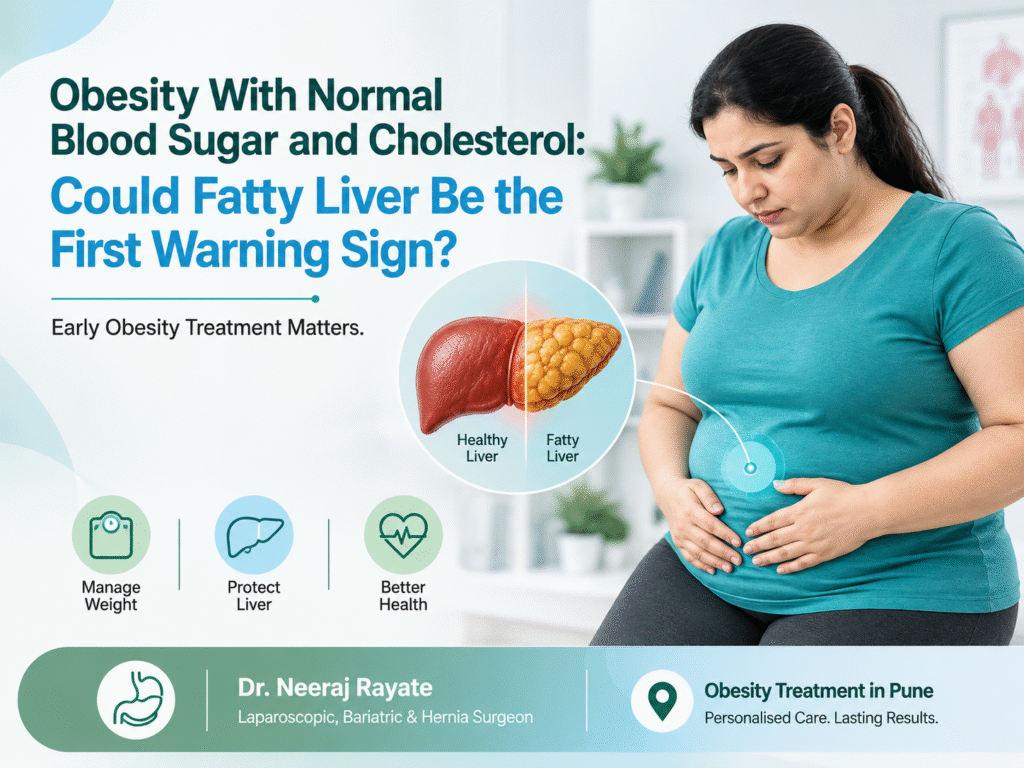
Fatty Liver and the Importance of Early Obesity Treatment in Pune
Normal blood sugar and cholesterol reports can feel reassuring, especially for someone living with obesity. It may seem logical to assume that if these common metabolic tests are normal, excess weight has not yet affected internal health.
However, metabolic changes do not always appear in every blood test at the same time.
One condition that may develop quietly is metabolic dysfunction-associated steatotic liver disease, or MASLD, previously commonly called non-alcoholic fatty liver disease.
The condition occurs when excess fat accumulates within the liver in association with metabolic risk factors. Obesity is an important risk factor, even when blood glucose and cholesterol have not yet reached abnormal ranges.
This is why comprehensive obesity treatment in Pune should focus on overall health rather than relying only on the weighing scale or a few normal laboratory reports.
What Is Fatty Liver Disease?
The liver normally contains a small amount of fat.
When excessive fat accumulates within liver cells, steatotic liver disease can develop.
Some people have relatively uncomplicated fat accumulation, while others develop inflammation and liver cell injury. Over time, persistent inflammation can contribute to fibrosis or scarring in a proportion of patients.
The American Association for the Study of Liver Diseases (AASLD) recognizes obesity and metabolic dysfunction as major factors associated with fatty liver disease.
Can You Have Fatty Liver With Normal Blood Sugar?
Yes.
Diabetes significantly increases the risk of fatty liver disease, but diabetes is not required for liver fat to accumulate.
A person may have obesity and insulin resistance before fasting glucose or HbA1c reaches the diagnostic range for diabetes.
Therefore, a normal glucose report is reassuring but does not prove that the liver contains no excess fat.
What If Your Cholesterol Is Normal Too?
The same principle applies.
Abnormal triglycerides and cholesterol commonly accompany metabolic disease, but normal lipid values do not completely exclude fatty liver.
Metabolic health involves multiple organs and processes.
Blood pressure, waist circumference, liver health, glucose regulation, sleep and other factors can all provide different information.
Why Can Fat Accumulate in the Liver?
Excess energy can be stored in adipose tissue, but metabolic changes may also increase the delivery and production of fatty acids within the liver.
Insulin resistance plays an important role for many patients.
Risk can be influenced by:
- Excess body weight, particularly abdominal obesity
- Insulin resistance or diabetes
- Metabolic syndrome
- Abnormal triglycerides
- Sleep apnea
- Genetic susceptibility
Not everyone with obesity develops the same degree of liver disease, which is why individual assessment matters.
Does Fatty Liver Cause Symptoms?
Often, no.
Many people discover fatty liver incidentally during an ultrasound performed for another reason.
Some may report fatigue or vague discomfort in the upper right abdomen, but these symptoms are not specific enough to diagnose liver disease.
A person can therefore feel completely well while liver fat is present.
Can Liver Tests Be Normal?
Yes.
Normal liver enzyme levels do not always exclude clinically important fatty liver disease.
AASLD guidance emphasizes the importance of evaluating metabolic risk and fibrosis rather than relying solely on liver enzyme levels.
This is particularly relevant for people with obesity who assume that normal liver tests mean their liver is definitely unaffected.
Why Does Fibrosis Matter?
Fat accumulation alone is not the only concern.
In some people, ongoing metabolic stress and inflammation can lead to fibrosis, meaning scar tissue develops within the liver.
Advanced fibrosis can eventually progress to cirrhosis.
The rate of progression varies substantially, and many people with simple fatty liver will never develop advanced liver disease.
The important goal is identifying people who may be at greater risk.
How Is Fatty Liver Evaluated?
Assessment may include medical history, blood tests and imaging.
Ultrasound can detect significant liver fat but does not perfectly determine how much inflammation or fibrosis is present.
Doctors may use non-invasive fibrosis calculations based on blood tests or specialized imaging such as elastography when clinically appropriate.
Further evaluation is individualized according to risk.
Can Weight Loss Improve Fatty Liver?
Weight reduction is one of the most important strategies for improving metabolic fatty liver disease in people who are overweight or have obesity.
AASLD guidance notes that weight loss can improve liver fat, and greater sustained weight reduction may also improve inflammation and fibrosis.
The objective should be clinically meaningful, sustainable weight management rather than repeated crash dieting.
Does Everyone With Obesity Need Bariatric Surgery?
No.
Obesity treatment can include nutrition therapy, physical activity, behavioral support, appropriate medications and metabolic or bariatric surgery.
The appropriate approach depends on BMI, obesity-related conditions, previous treatment attempts and individual circumstances.
Bariatric surgery is an evidence-based treatment for appropriately selected patients, but it is not automatically recommended simply because fatty liver is found.
Why Is Early Obesity Treatment Important?
Waiting until diabetes or high cholesterol develops can mean missing an opportunity for earlier intervention.
Obesity can affect several systems before routine blood tests become abnormal.
Liver fat, sleep apnea, joint problems, fertility issues and other complications can appear at different stages.
Modern obesity care therefore considers the entire health picture rather than treating obesity only when another disease appears.
Should Fatty Liver Be a Wake-Up Call?
It can be viewed as an important metabolic signal rather than a reason for panic.
An ultrasound showing fatty liver does not mean liver failure is inevitable.
For many people, the condition provides an opportunity to address weight and metabolic health while significant liver damage may still be preventable.
The focus should be on evidence-based, sustainable management.
Obesity Treatment in Pune With Dr. Neeraj Rayate
If you have obesity but normal blood sugar and cholesterol, it is still worth considering your broader metabolic health.
Dr. Neeraj Rayate provides assessment for people seeking obesity treatment in Pune, including evaluation of weight-related health concerns and discussion of appropriate medical or surgical weight management options.
Treatment should be individualized according to overall health, weight history, metabolic risks and previous attempts at weight management rather than being based on BMI alone.
Frequently Asked Questions
1. Can I have fatty liver even if my cholesterol is normal?
Yes. Abnormal cholesterol can accompany fatty liver, but normal cholesterol does not rule it out. Obesity and other metabolic factors can still contribute to liver fat accumulation.
2. Can fatty liver be reversed with weight loss?
Liver fat can improve significantly with sustained weight reduction in many people. The amount of improvement depends on the severity of disease and the degree of sustainable weight loss.
3. Does fatty liver mean I need bariatric surgery?
Not automatically. Treatment depends on BMI, metabolic health, liver risk, previous weight-loss attempts and other factors. Bariatric surgery is one option for appropriately selected patients.
#obesitytreatmentinpune #obesitytreatment #fattyliver #masld #metabolichealth #weightmanagement #bariatricsurgeryinpune #drneerajrayate